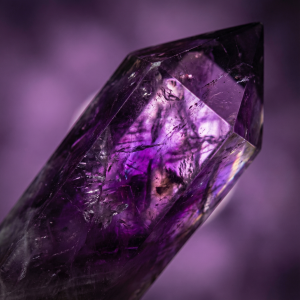

As morning light filters through the display, a raw piece of citrine quartz casts warm golden specks onto a minimalist brass tray beside it—here, the raw energy of minerals engages in silent dialogue with modern, refined design.
On Aurafeng’s product shelves, the Citrine Feng Shui Money Tree always occupies a prominent place. More than just a bestseller, it encapsulates the brand’s core philosophy: transforming natural minerals carrying auspicious meanings into desktop art pieces that align with contemporary aesthetics.
In traditional Feng Shui, yellow represents wealth and the earth element, and citrine is believed to enhance the wealth energy within one’s personal aura. Aurafeng doesn’t simply present a raw crystal; instead, it is meticulously crafted into a “money tree” form.
Each “leaf” is a hand-selected and polished citrine, while the branches are made of matte black metal, creating a striking contrast between the natural and the crafted, the organic and the geometric. This design thinking permeates the entire product line.
01 The Principle of Healing: The Scientific Connection to Natural Energy
Aurafeng’s commitment to crystal energy is not baseless. Although crystal healing remains controversial in mainstream science, the brand ensures its conceptual foundation through material authenticity.
All crystals are 100% naturally sourced, meaning they formed over millions of years in geological environments, maintaining their complete crystalline structure. In mineralogy and vibrational theory, different crystals do possess distinct physical vibrational properties.
Citrine belongs to the quartz family, its warm hue deriving from trace amounts of iron. From a psychological perspective, connecting with these natural objects from the depths of the Earth can indeed help urban dwellers temporarily disconnect from manufactured environments, providing a grounding sense of calm.
Aurafeng skillfully bridges this potential healing property with modern needs for anxiety relief. Products don’t overstate effects but emphasize neutral concepts like “energy” and “balance,” allowing users to explore and feel for themselves.
02 Craftsmanship Details: Ritual Beginning from Unboxing
The process of opening an Aurafeng product is designed as a stress-relieving ritual in itself. The texture of eco-friendly paper, the carefully designed unboxing sequence, the included instruction card—every detail conveys respect for the “object.”
This “spirit of reverence for objects” draws from Japanese wabi-sabi aesthetics and the Eastern philosophical emphasis on “vessels.” In Buddhist tradition, ritual objects used by practitioners are often exquisitely made, expressing respect for the practice itself.
Aurafeng modernizes this concept: an object designed to help modern seekers find inner peace should itself deliver a peaceful experience. The clean, eco-friendly shipping box, the soft-touch inner lining, the simple yet poetic text on the instruction card—all combine to create a holistic first impression.
The brand even considers gifting scenarios, offering customizable greeting card services. This is not merely an add-on but transforms the act of “gifting” into a complete ritual for conveying good wishes and positive energy.
03 The Way of Integration: Translating Eastern Philosophy into Space
Articles in Aurafeng’s blog, like “Minimalist Japanese-inspired Furniture” and “Creative Water Features,” reveal the brand’s deeper ambition: not just selling items, but teaching a philosophy for planning living spaces.
Feng Shui is often misunderstood in the West as mysticism, but it is essentially an ancient system of environmental psychology and spatial planning. It focuses on how airflow, light, color, and layout affect the emotions and energy of inhabitants.
Aurafeng’s product design incorporates these principles subtly: the Citrine Money Tree is suggested for placement in the “wealth corner” (typically the southeast) of a space; water features help regulate humidity and create soothing white noise; and all product dimensions consider the spatial constraints of modern apartments.
This attempt to miniaturize and practicalize grand philosophy allows consumers to benefit without deep study of the I Ching. A blog guide on “energy optimization for small apartments” demonstrates how just three carefully placed items can significantly alter a space’s atmospheric feel.
04 Cultural Translation: Modern Interpretations of Traditional Symbols
Aurafeng’s most challenging task is transforming symbols with strong religious and cultural connotations—like Buddhist prayer beads, Taoist trigrams, or Feng Shui compasses—into a universal aesthetic language.
The brand’s solution is to extract the core spirit and innovate the form. A bracelet based on Buddhist prayer beads retains the traditional 108 beads (representing the 108 earthly desires) but uses gradient-colored crystals and a modern clasp instead of traditional knots.
Similarly, the Tai Chi Yin-Yang symbol is no longer presented as a flat black-and-white image but as a three-dimensional sculpture carved from two metals with different textures, creating dynamic interplay with light and shadow. This approach of “de-emphasizing religiosity while preserving philosophy” allows products to appeal to global customers curious about Eastern wisdom while avoiding cultural appropriation pitfalls.
Product descriptions are carefully crafted, focusing on the underlying philosophical concepts of balance, cycle, and harmony rather than specific religious rituals. This makes each product a starting point for cultural conversation, not an end point.
In a corner of the showroom, a young customer tries on the crystal bracelet redesigned from prayer beads. She may not know the full Buddhist significance of the 108 beads, but she feels the calming rhythm as her fingers glide over each smooth crystal.
This sense of calm is the invisible bridge connecting ancient wisdom to contemporary life. Aurafeng’s success lies not in trying to pull modern people back to the past, but in translating ancient wisdom of tranquility into a daily language that modern people can understand and use.